
Events
Past Event
WED@NICO WEBINAR: Tauhid Zaman, Yale School of Management "Detecting Bots and Assessing Their Impact in Social Networks"
Northwestern Institute on Complex Systems (NICO)
12:00 PM
Details
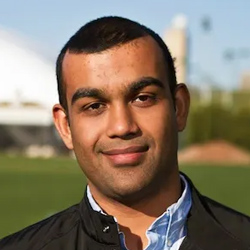
Speaker:
Tauhid Zaman, Associate Professor of Operations Management, Yale School of Management
Title:
Detecting Bots and Assessing Their Impact in Social Networks
Abstract:
Online social networks are often subject to influence campaigns by malicious actors through the use of automated accounts known as bots. We consider the problem of detecting bots in online social networks and assessing their impact on the opinions of individuals. We begin by developing a bot detection algorithm based on the Ising model from statistical physics. This algorithm can simultaneously identify multiple bots based on their network interaction patterns. Our Ising model algorithm can identify bots with higher accuracy while utilizing much less data than other state of the art methods.
We then develop a function we call generalized harmonic influence centrality to estimate the impact bots have on the opinions of users in social networks. This function is based on a generalized opinion dynamics model which subsumes many other models. We prove that this model reaches an equilibrium characterized by a set of linear equations. By combining a neural network for measuring sentiment with the observed social network structure, we are able to calculate the generalized harmonic influence centrality of bots in multiple real social networks involving the 2016 US presidential election, Brexit, and the Gilets Jaunes protests in France. For some networks we find that a limited number of bots can cause non-trivial shifts in the population opinions. In other networks, we find that the bots have little impact. Overall we find that generalized harmonic influence centrality is a useful operational tool to measure the impact of bots in social networks.
Speaker Bio:
Tauhid Zaman is an Associate Professor of Operations Management at the Yale School of Management. He received his BS, MEng, and PhD degrees in electrical engineering and computer science from MIT. His research focuses on solving operational problems involving social network data using probabilistic models, network algorithms, and modern statistical methods. Some of the topics he studies in the social networks space include combating online extremists and assessing the impact of bots. His broader interests cover data driven approaches to investing in startup companies, algorithmic sports betting, and biometric data. His work has been featured in the Wall Street Journal, Wired, Mashable, the LA Times, and Time Magazine.
Webinar:
Zoom link: https://northwestern.zoom.us/j/92654679478
Passcode: nico
About the Speaker Series:
Wednesdays@NICO is a vibrant weekly seminar series focusing broadly on the topics of complex systems and data science. It brings together attendees ranging from graduate students to senior faculty who span all of the schools across Northwestern, from applied math to sociology to biology and every discipline in-between. Please visit: https://bit.ly/WedatNICO for information on future speakers.
Time
Wednesday, April 28, 2021 at 12:00 PM - 1:00 PM
Contact
Calendar
Northwestern Institute on Complex Systems (NICO)
WED@NICO SEMINAR: Lightning Talks with NU Scholars!
Northwestern Institute on Complex Systems (NICO)
12:00 PM
//
Lower Level, Chambers Hall
Details
May 20th Speakers:
Yulin Yu, Postdoctoral Fellow, Kellogg School of Management
Feihong Xu, PhD Candidate, McCormick School of Engineering
Maalvika Bhat, PhD Student, School of Communication
Rochana Chaturvedi, Postdoctoral Fellow, Kellogg School of Management
NICO Lightning talks are open to Northwestern graduate students, postdoctoral fellows, and visiting scholars! If you are interested in signing up for a future session, please fill out this short survey.
Talk Titles and Abstracts:
Yulin Yu
Postdoctoral Fellow
Kellogg School of Management &
Northwestern Institute on Complex Systems
Human–AI Creative Pathways: How People and Machines Differ in Creative Strategy
Generative AI offers the promise of amplifying creativity by recombining knowledge at a scale far beyond human capacity, yet humans still hold key advantages in flexibility and contextual reasoning. To understand how each achieves novelty, we analyzed more than 5,000 responses to the Divergent Association Task from both humans and AI systems using network-based methods. We find that while individual humans use fewer and simpler conceptual categories than machines, the collective diversity of human ideas is substantially higher. Human creative pathways tend to follow a one-directional but highly unpredictable trajectory, whereas AI systems rely on repetitive, back-and-forth exploration patterns. Finally, both humans and machines show anchoring effects—early ideas shape later responses—but in opposite ways: humans anchor low, while machines anchor high.
Feihong Xu
PhD Candidate
Engineering Sciences & Applied Mathematics
McCormick School of Engineering
A Well-Calibrated Model Similarity Measure for Arbitrary Neural Networks
Deep learning approaches have transformed biological and biomedical image analysis, but model opacity and fragility remain major obstacles to trustworthy use. One barrier is the lack of a well-calibrated measure of similarity across arbitrary neural networks trained with different architectures, checkpoints, random initializations, and training strategies. Existing notions of model similarity span functional and representational domains, often rely on heuristic assumptions, and are susceptible to spurious signals introduced by probing samples, making principled cross-model meta-analysis difficult. Here, we clarify prevailing notions of deep neural network similarity and benchmark their robustness under extensive out-of-distribution perturbations. We then introduce the Ahmad RV coefficient on chain weight matrices (wARV), a theoretically grounded weight-space similarity measure that combines chain-normalized weights with the RV coefficient. wARV is sample-agnostic, symmetric, computationally efficient, and better calibrated than current measures. Across benchmarks varying random initialization, training checkpoint, architecture, and training strategy, wARV more faithfully tracks functional similarity while avoiding confounding effects from probing data. Applying wARV to deep neural network models on both generic and medical image classification tasks, we uncover substantial learning heterogeneity and instability even among models with similar predictive performance.
Maalvika Bhat
PhD Student
Technology and Social Behavior
School of Communication &
McCormick School of Engineering
Scholars See Clickbait as a Greater Threat to Science Than to Their Own Work
As scientific research competes for attention in a media landscape driven by sensationalism, the risks of misrepresentation grow. This study examines whether academics, while widely recognizing clickbait as a threat to science broadly, tend to downplay its relevance to their own work. Surveying 5,603 U.S.-based researchers, we find a consistent perception gap between systemic and personal risk, one that varies by career stage and disciplinary context. Early-career scholars show a pronounced version of this asymmetry: they express heightened concern about clickbait’s harms to science while rating its relevance to their own work as comparatively lower, a pattern that leaves them most exposed at a stage when reputational stakes are highest.
Rochana Chaturvedi
Postdoctoral Fellow
Kellogg School of Management &
Northwestern Institute on Complex Systems
Who Gets the Callback? Generative Artificial Intelligence and Gender Bias
Large language models are increasingly embedded in hiring workflows, raising concerns about their potential to amplify societal biases — yet how these biases manifest within and across occupations, and the role of model 'personality' in shaping these biases, remains unexplored. We introduce a three-part attribution framework applied to 332,044 real-world job ads, measuring gender-based callback bias, associations of skills and traits with gendered stereotypes in LLMs, and the effect of simulated recruiter personas. We find that LLMs systematically favor men, especially in higher-wage roles, with their decisions tracking traditional gendered language cues in job postings. Notably, assigning a low-agreeableness persona reduces model bias, implicating sycophancy as a mechanism reinforcing societal stereotypes; at the same time, controversial personas trigger internal guardrails leading to more cautious and less-biased outputs. These findings highlight how alignment choices in AI-driven hiring systems shape bias, with important implications for fairness and diversity.
Location:
In person: Chambers Hall, 600 Foster Street, Lower Level
Remote option: https://northwestern.zoom.us/j/98031689779
About the Speaker Series:
Wednesdays@NICO is a vibrant weekly seminar series focusing broadly on the topics of complex systems, networks, and artificial intelligence. It brings together attendees ranging from graduate students to senior faculty who span all of the schools across Northwestern, from applied math to sociology to biology and every discipline in-between. Please visit: https://bit.ly/WedatNICO for information on future speakers.
Time
Wednesday, May 20, 2026 at 12:00 PM - 1:00 PM
Location
Lower Level, Chambers Hall Map
Contact
Calendar
Northwestern Institute on Complex Systems (NICO)